Infrared Laser Ablation with Vacuum Capture for Fingermark Sampling

F. Donnarumma, E.E. Camp, F. Cao, K.K. Murray, “Infrared Laser Ablation with Vacuum Capture for Fingermark Sampling”, Fabrizio Donnarumma, Eden E. Camp, Fan Cao & Kermit K. Murray, J. Am. Soc. Mass Spectrom. 51 (2017) 1958–1964. doi:10.1007/s13361-017-1703-2.

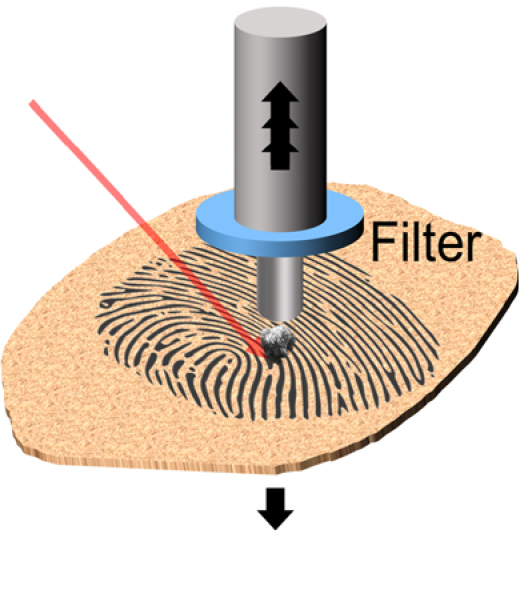
Abstract: Infrared laser ablation coupled to vacuum capture was employed to collect material from fingermarks deposited on surfaces of different porosity and roughness. Laser ablation at 3 ΞΌm was performed in reflection mode with subsequent capture of the ejecta with a filter connected to vacuum. Ablation and capture of standards from fingermarks was demonstrated on glass, plastic, aluminum, and cardboard surfaces. Using matrix assisted laser desorption ionization (MALDI), it was possible to detect caffeine after spiking with amounts as low as 1 ng. MALDI detection of condom lubricants and detection of antibacterial peptides from an antiseptic cream was demonstrated. Detection of explosives from fingermarks left on plastic surfaces as well as from direct deposition on the same surface using gas chromatography mass spectrometry (GC-MS) was shown.

Fingermark ablation
Fingermark ablation from J. Am. Soc. Mass Spectrom. 28 (2017) 1958

Pulsed Valve Matrix-assisted Ionization

B. Banstola, K.K. Murray, Pulsed valve matrix-assisted ionization, Analyst. 142 (2017) 1672–1675. doi:10.1039/c7an00489c.

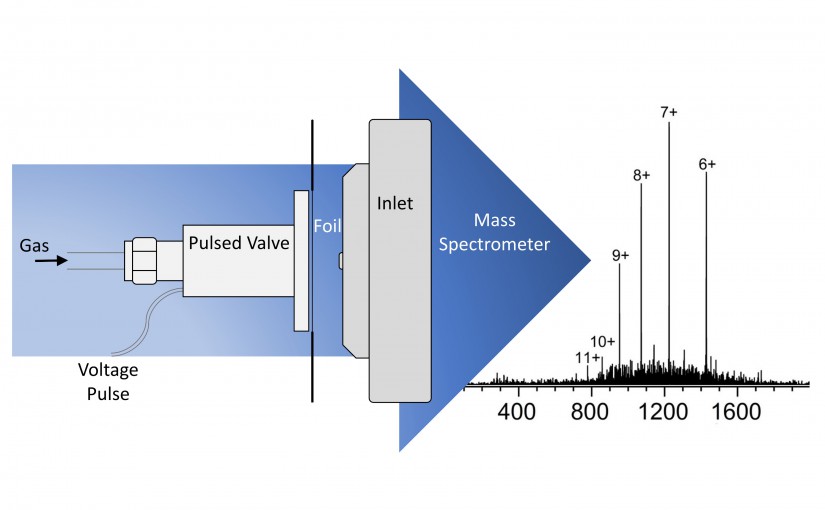
Abstract: We have developed a new ionization approach for matrix-assisted ionization with high temporal resolution using an electrically actuated pulsed valve. Matrix and analyte samples are deposited on a thin metal foil and placed at the inlet of an ambient ionization mass spectrometer. When the pulsed valve is actuated, a short puff of high pressure gas impinges on the foil and ejects particulate from the sample on the opposite side. Highly charged ions are formed from the particles at the mass spectrometer inlet. Using this source, multiply charged protein ions are produced within a selectable 4 second time window.

PV MAI Schematic
Banstola & Murray, Analyst, 2017

Systematic assessment of surfactants for matrix-assisted laser desorption/ionization mass spectrometry imaging

B. Banstola, E.T. Grodner, F. Cao, F. Donnarumma, K.K. Murray, Systematic assessment of surfactants for matrix-assisted laser desorption/ionization mass spectrometry imaging, Anal. Chim. Acta. 963 (2017) 76–82. doi:10.1016/j.aca.2017.01.054.

Abstract

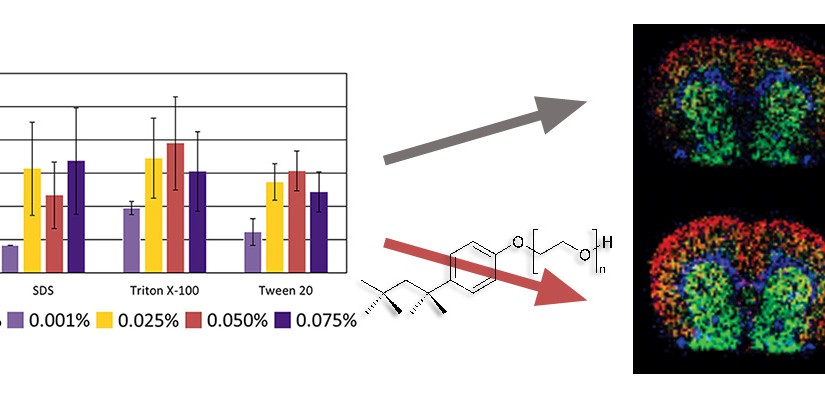
Systematic assessment of surfactants
B. Banstola, E.T. Grodner, F. Cao, F. Donnarumma, K.K. Murray, Systematic assessment of surfactants for matrix-assisted laser desorption/ionization mass spectrometry imaging, Anal. Chim. Acta. 963 (2017) 76–82. doi:10.1016/j.aca.2017.01.054.

A systematic method for evaluation of MALDI profiling and imaging was developed and applied to the use of three surfactants, sodium dodecyl sulfate (SDS), Triton X-100, and Tween 20, on rat brain tissue. For profiling studies, mass spectra were acquired from regular arrays of spots with manually deposited surfactant and matrix. The studies recorded the total number of peaks in the mass spectra from 2 to 20 kDa and compared the number of peaks and peak intensities with and without surfactant. It was found that SDS decreases the total number of peaks at all concentrations but does lead to an increase in the number of peaks below 5 kDa. Triton X-100 at 0.05% concentration yielded the highest number of peaks and highest number of new peaks, with the best results above 5 kDa. Correlation of the increase in signal with the estimated hydrophobicity suggests that Triton X-100 improves mass spectrometry quality through an increase in the intensity of hydrophobic protein peaks. Tween 20 provided good performance at 0.05% concentration across all mass ranges. For imaging studies, multiple images were obtained and the integrated intensity ratio for images obtained with and without surfactant was compared for 10 selected peaks. It was found that SDS tends to degrade imaging performance whereas Triton X-100 and Tween 20 improved performance compared to no surfactant, especially above 7 kDa.

LSU Chemistry Sweeps STEM Rainmaker Awards

Rainmakers in Research Recognized

2107 LSU Rainmakers
At the LSU Rainmakers event were, left to right: Provost Rick Koubek, Campus Federal Credit Union President and CEO Dawn Harris, Associate Vice President for Research & Economic Development Stephen David Beck, Associate Professor Donghui Zhang, Associate Vice President for Research & Economic Development Gus Kousoulas, the Mary P. Poindexter Professor of Mass Communication Lance Porter, Assistant Professor Rendy Kartika, Vice President of Research & Economic Development Kalliat T. Valsaraj, Roy Paul Daniels Professor of Chemistry Kermit Murray, the Louise & Kenneth Kinney Professor of Black Drama and Playwriting Femi Euba, and Assistant Professor Benjamin Kahan. Photo Credit: Cody Willhite, LSU